
QUESTION SET · LIVING IN A DEMOCRACY
Questions on: The Federal Election: First Vote, Second Vote, 5 Per Cent Threshold
15 of the 150 questions on Living in a democracy belong here. Under each question you read what it is about; the article explains the wider context.
Read the background: The Federal Election: First Vote, Second Vote, 5 Per Cent Threshold
The test is only in German, so the questions are shown in their official German wording.
Question 93 of 300
Je mehr „Zweitstimmen“ eine Partei bei einer Bundestagswahl bekommt, desto …
What it is about
In Germany, with the first vote you elect a person in your constituency, with the second vote a party. Both votes are cast in every federal election.
The four answer options and the correct answer are in the app, where you practise with instant feedback.
Further readingDas Wahlsystem - Die Bundeswahlleiterin
Question 105 of 300
Was ist eine Aufgabe von Wahlhelfern / Wahlhelferinnen in Deutschland?
What it is about
On election day, voluntary helpers support the election board in the polling stations. Under the Federal Elections Act, election day is a Sunday or a public holiday.
The four answer options and the correct answer are in the app, where you practise with instant feedback.
Further readingInformationen für Wahlhelfende - Die Bundeswahlleiterin
Question 106 of 300
In Deutschland helfen ehrenamtliche Wahlhelfer und Wahlhelferinnen bei den Wahlen. Was ist eine Aufgabe von Wahlhelfern / Wahlhelferinnen?
What it is about
In Germany, tens of thousands of polling districts have been set up, each run by an election board. The helpers work on a voluntary basis.
The four answer options and the correct answer are in the app, where you practise with instant feedback.
Further readingInformationen für Wahlhelfende - Die Bundeswahlleiterin
Question 107 of 300
Für wie viele Jahre wird der Bundestag in Deutschland gewählt?
What it is about
The first German Federal Parliament (Bundestag) was elected on 14 August 1949. Since 1999 the parliament has met in the Reichstag building in Berlin.
The four answer options and the correct answer are in the app, where you practise with instant feedback.
Further readingGrundgesetz für die Bundesrepublik Deutschland
Question 109 of 300
Wie oft gibt es normalerweise Bundestagswahlen in Deutschland?
What it is about
Federal elections recur at fixed intervals laid down by the Basic Law (Grundgesetz). Early new elections are possible only in cases regulated by law.
The four answer options and the correct answer are in the app, where you practise with instant feedback.
Further readingGrundgesetz für die Bundesrepublik Deutschland
Question 110 of 300
Für wie viele Jahre wird der Bundestag in Deutschland gewählt?
What it is about
Under the Basic Law (Grundgesetz), the legislative term ends only with the first sitting of a new Federal Parliament (Bundestag). Until then the existing Federal Parliament remains in office.
The four answer options and the correct answer are in the app, where you practise with instant feedback.
Further readingGrundgesetz für die Bundesrepublik Deutschland
Question 113 of 300
Wahlen in Deutschland gewinnt die Partei, die …
What it is about
The Basic Law (Grundgesetz) lays down that federal elections must be universal and direct. How the will of the voters is converted into seats is regulated by the Federal Elections Act.
The four answer options and the correct answer are in the app, where you practise with instant feedback.
Further readingDas Wahlsystem - Die Bundeswahlleiterin
Question 117 of 300
Wie viel Prozent der Zweitstimmen müssen Parteien mindestens bekommen, um in den Deutschen Bundestag gewählt zu werden?
What it is about
In the federal election, the second vote is decisive for the distribution of seats among the parties. The first vote decides direct mandates in the constituencies.
The four answer options and the correct answer are in the app, where you practise with instant feedback.
Further readingDas Wahlsystem - Die Bundeswahlleiterin
Question 120 of 300
Das Wahlsystem in Deutschland ist ein …
What it is about
Electoral systems regulate how votes become seats in parliament. Under majority voting, the person with the most votes in a constituency wins. Under proportional representation, parties receive as many seats as correspond to their share of the votes. In a federal election you have two votes: the first vote for a person in the constituency and the second vote for a party. Earlier systems such as the Prussian three-class franchise gave wealthy citizens more weight.
The four answer options and the correct answer are in the app, where you practise with instant feedback.
Further readingDas Wahlsystem - Die Bundeswahlleiterin
Question 121 of 300
Eine Partei möchte in den Deutschen Bundestag. Sie muss aber einen Mindestanteil an Wählerstimmen haben. Das heißt …
What it is about
The rules for federal elections are in the Federal Elections Act. The Federal Constitutional Court (Bundesverfassungsgericht) examines whether they are compatible with the Basic Law (Grundgesetz). They are repeatedly the subject of public debate.
The four answer options and the correct answer are in the app, where you practise with instant feedback.
Further readingDas Wahlsystem - Die Bundeswahlleiterin
Question 123 of 300
Was ist in Deutschland die „5 %-Hürde“?
What it is about
In the federal election there are constituencies in which direct candidates stand, and in addition the parties’ state lists are elected. Both votes together shape the election result.
The four answer options and the correct answer are in the app, where you practise with instant feedback.
Further readingDas Wahlsystem - Die Bundeswahlleiterin
Question 126 of 300
Was bekommen wahlberechtigte Bürger und Bürgerinnen in Deutschland vor einer Wahl?
What it is about
In Germany, people entitled to vote generally do not have to register themselves before an election, because the electoral register is kept automatically by the authorities.
The four answer options and the correct answer are in the app, where you practise with instant feedback.
Further readingBundeswahlordnung
Question 127 of 300
Warum gibt es die 5 %-Hürde im Wahlgesetz der Bundesrepublik Deutschland? Es gibt sie, weil …
What it is about
Electoral rules must comply with the principle of equality of the vote, and the Federal Constitutional Court (Bundesverfassungsgericht) checks them against it. Deviations from it are permitted only for compelling reasons.
The four answer options and the correct answer are in the app, where you practise with instant feedback.
Further readingBundesverfassungsgericht: Urteil zur Sperrklausel im BundestagswahlrechtBundesverfassungsgericht: Beschluss zur Fünf-Prozent-Sperrklausel
Question 130 of 300
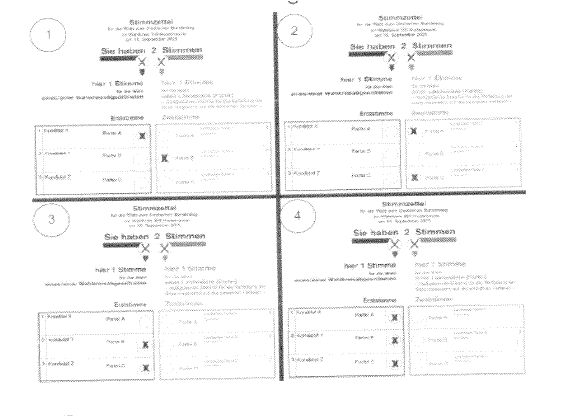
Welcher Stimmzettel wäre bei einer Bundestagswahl gültig?
What it is about
With the ballot paper for the federal election you cast two votes: on the left the first vote for a person in the constituency, on the right the second vote for a party. A ballot paper is valid if the voter’s intention is clearly recognisable. Anyone who puts more than one cross in a column, writes something on it or marks the paper makes the vote invalid.
The four answer options and the correct answer are in the app, where you practise with instant feedback.
Further readingDie Bundeswahlleiterin: Das WahlsystemDie Bundeswahlleiterin: Ungültiger Stimmzettel
Question 133 of 300
Was ist bei Bundestags- und Landtagswahlen in Deutschland erlaubt?
What it is about
After each federal election, the Federal Returning Officer publishes the results in all constituencies. The official final result is formally determined and announced later.
The four answer options and the correct answer are in the app, where you practise with instant feedback.
Further readingDie Bundeswahlleiterin: Briefwahl
Do you know the answers?
In the app you practise all 310 questions of your test with instant feedback, explanations and an exam simulation.